

Megascreens Predicts Direct View LED Technology Trends for 2026

What’s becoming possible, and what’s becoming expected
Indoor direct view LED is entering a different phase in 2026.
The core story is the same as 2025: finer pixel pitches, better durability, simpler deployment, stronger processing, and more predictable lifecycle performance. What changes this year is accessibility. The best ideas are no longer reserved for a small set of flagship budgets. They are filtering into more brands, more spaces, and more practical use-cases.
For Megascreens, that matters because our niche is not “LED walls in general”. It’s indoor, fine pitch DV LED in brand-critical environments where the screen has to feel deliberate, run reliably, and protect the look of the space.
Here are the trends we expect to define 2026.
1) Immersion becomes the brief, not an add-on
The most important 2026 theme is immersion.
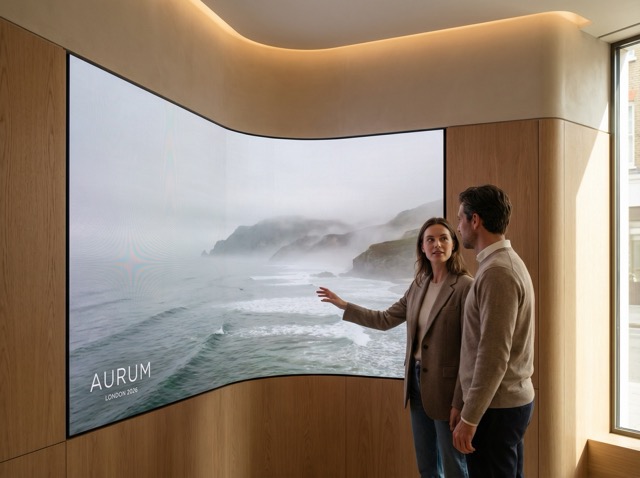
Not the VR kind. The architectural kind. DV LED is being specified as part of the space, so visitors feel like they’re inside an environment, not looking at a screen.
This is happening because three things are converging:
Ultra-fine pitch brings people closer
As ultra-fine pitch options mature, the “safe viewing distance” shrinks. It becomes viable to place LED in environments where people stand close, linger, and look for detail. Industry launches are now pushing into sub-1.0mm pitches in premium indoor lines, which supports higher perceived sharpness and better close-up realism.
Seamless surfaces enable spatial continuity
Zero bezels and modular builds are not new. What’s changing is how designers use them. We’re seeing more non-standard aspect ratios, panoramic canvases, and LED surfaces that intentionally wrap corners, door reveals, and architectural recesses.
The end goal is continuity. One visual language across wall sections, not “a rectangle stuck on a wall”.
LED expands across walls, ceilings, and transitions
Immersion accelerates when you remove hard edges. The most advanced installations now use multiple synchronised LED planes to create a programmable volume. Recent experiential retail builds in London show this direction clearly: multi-surface environments driven by high resolution LED and synchronised media systems.
Megascreens lens: immersion only works if the integration is disciplined. Sightlines, reflections, service access, acoustic considerations, and the “screen-off” appearance all matter as much as the content.
2) Transparent and light-permeable LED becomes a real design tool
Transparent LED is no longer just a novelty for window gimmicks. In 2026, it’s being used more thoughtfully:
- to keep natural daylight entering the space
- to layer brand storytelling over a real architectural view
- to soften the boundary between digital content and physical environment
This is particularly relevant in retail and hospitality, where the space must feel open, not sealed behind a black wall.
The design trick is restraint. Transparent LED works best with content that respects its nature: high-contrast brand shapes, minimal typography, slow movement, and intentional negative space.
3) Interaction becomes more normal, and more accountable
In 2025, interactivity was often framed as “wow”. In 2026, it’s being framed as utility and engagement, especially in experience centres, corporate lobbies, museums, and premium retail.
Sensors and detection methods are becoming easier to deploy:
- motion sensing for proximity and gesture response
- infrared for touchless interaction
- camera-based tracking for audience flow and dwell behaviour
Some immersive venues are already combining LED environments with analytics such as footfall and dwell measurement.
Two realities come with this trend:
- Interaction must be designed to feel natural, not performative.
- Privacy and governance must be explicit. If camera recognition or analytics are used, it needs clear intent, compliant handling, and visible transparency.
Megascreens lens: the most effective interactive work is calm. It responds subtly. It helps people understand where to go, what to do next, or what a product or organisation stands for.
4) Packaging and surface durability moves from “spec” to “default”
A big undercurrent of 2026 is the shift in LED packaging and protection.
COB continues to grow in premium indoor applications because it supports tighter pitches and improves durability and uniformity. TrendForce has highlighted the increasing prominence of COB in the video wall market, including pushes around high-end all-in-one formats at fine pitch.
COB’s core principle is straightforward: mounting LED chips directly onto the board rather than using traditional packaged SMD, which changes durability and optical behaviour.
At the same time, MiP is gaining visibility for ultra-fine pitch directions and high-density builds. Immersive environments are already using MiP alongside COB in the wild.
For end users, this trend translates into:
- fewer compromises in busy public spaces
- better resilience for close-contact environments
- improved confidence specifying fine pitch in real-world locations
5) All-in-one systems keep improving, making LED easier to adopt
2026 is also about accessibility. Many brands want DV LED, but they don’t want complex build programmes for every room.
All-in-one LED systems continue to evolve because they reduce friction:
- faster installation
- simplified calibration
- predictable form factors
- easier repeatability across sites
AV industry coverage has called out this broader shift toward all-in-one display solutions designed around deployment efficiency and versatility.
Megascreens lens: all-in-one is not “better”. It’s “better when the job is repeatability and simplicity”. For rooms where the screen must be architectural, custom-sized, or part of a spatial narrative, a permanent fine pitch wall remains the right approach.
6) Media and screen design converge
This is the trend many brands underestimate.
As screens become larger, closer, and more immersive, content can’t be treated like a scaled-up phone video. The entire creative process needs to change.
In 2026, the strongest work will come from teams that design for:
- real viewing distance and dwell time
- peripheral vision and comfort
- pacing that matches a space, not a feed
- transitions that respect architectural edges and joins
- colour grading tuned to the display and lighting conditions
Immersive spaces succeed when the media is authored for the environment. Not pasted onto it.
Practical takeaway: if you invest in a premium LED surface, invest in a content system that protects it: templates, governance, and a content cadence that stays calm.
What this means for brands in 2026
Indoor DV LED is becoming more like architecture and less like AV.
The brands that will benefit most are the ones that treat the screen as:
- a long-life surface
- an operational system
- a storytelling tool built around the space
Immersion, interaction, and authored media are not separate trends. They’re parts of the same shift: environments that feel alive, coherent, and intentional.
Frequently asked questions
Yes. DV LED displays are well suited to healthcare settings due to their high reliability, long lifespan, and excellent visibility. When specified correctly, they can be used safely in reception areas, waiting rooms, consultation spaces, and staff-only environments.
LED displays help patients feel more informed and at ease by providing clear wayfinding, appointment updates, and reassuring visual content. In waiting areas, they can reduce perceived wait times and create calmer, more welcoming environments.
Yes. LED screens can support telemedicine consultations, staff briefings, and internal communications by providing high-resolution visuals, accurate colour reproduction, and reliable performance for video and data sharing.
Modern DV LED systems are designed for minimal maintenance. Front-serviceable modules allow quick repairs without disruption, and remote monitoring enables proactive support — making them ideal for environments where uptime is critical.