

LED Video Wall vs LCD Video Wall: What Actually Changes

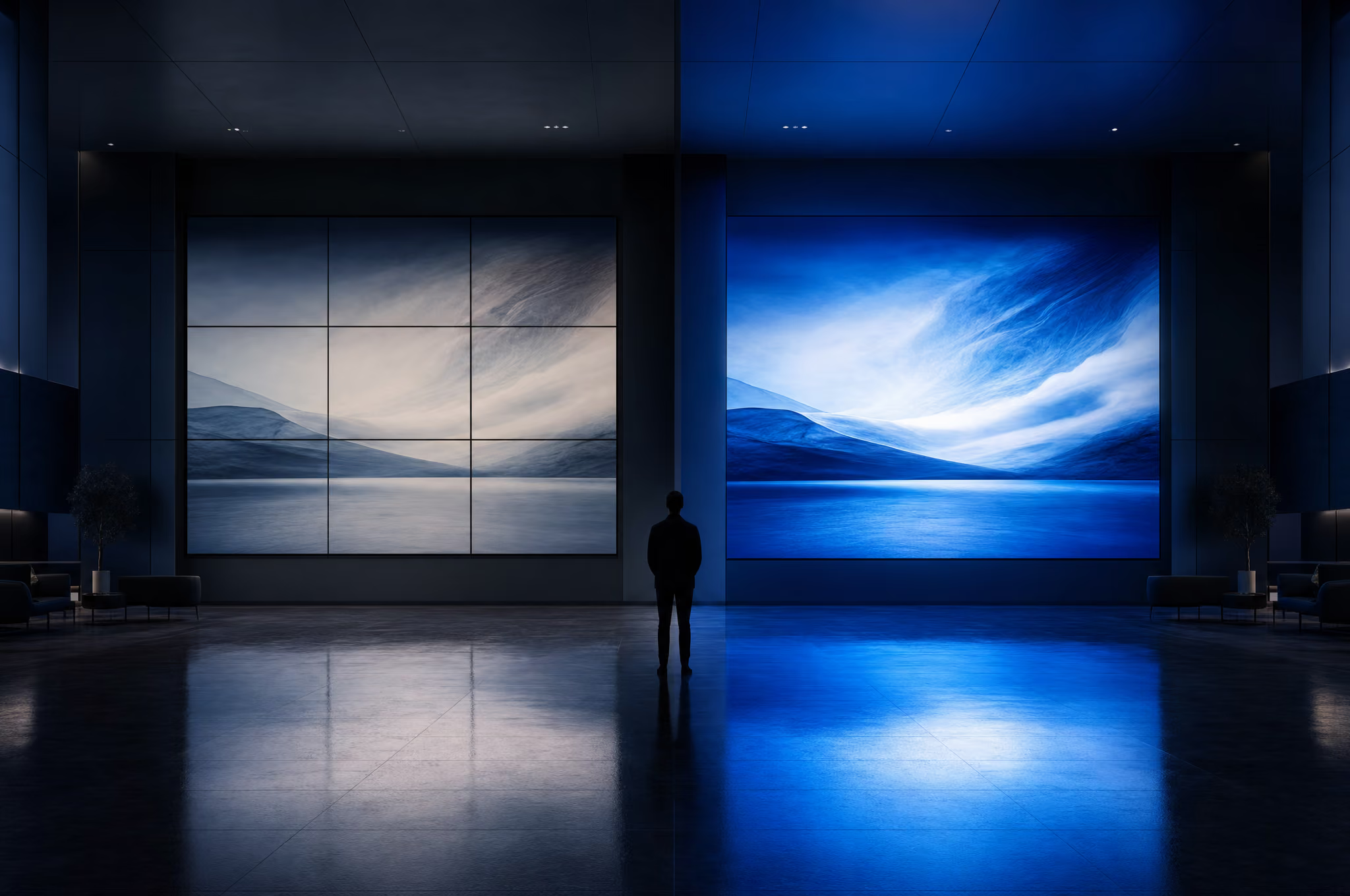
LED video wall or LCD video wall: what the difference actually costs you
Every brand-critical space eventually asks the same question. Do you specify an LED video wall, or tile together an LCD video wall from commercial screens?
Both put moving images on a wall. Past that, they solve different problems. The choice affects how the wall looks on day one, and how it performs three years later.
This is a technical comparison, so we will use the full terms once and then use them freely. LED video wall here means Direct View LED (DV-LED), where each pixel is an individual LED. LCD video wall means tiled commercial LCD panels, the same underlying technology as a large television, mounted edge to edge.
1. The seam is the first thing people notice
LCD panels have a physical border around the screen, the bezel. Tile several panels together and that border becomes a grid of dark lines across the image. Manufacturers have narrowed bezels over the years. They have not removed them.
DV-LED has no panel edges to hide. The display is built from LED modules that combine into one continuous surface. There is no grid, no seam, no interruption to the image, whatever size the wall grows to.
What the seam actually costs you:
- Content has to be composed around the grid, or the grid interrupts it.
- Faces, logos and fine typography can land directly on a mullion line.
- The wall reads as "screens on a wall" rather than "part of the architecture".
For content that needs to feel like architecture, not equipment, this single difference often settles the decision before any other spec is compared.
2. Brightness and colour under real light
LCD panels are lit from behind. A backlight pushes light through layers of glass and film to reach the surface. That limits peak brightness and can shift colour and contrast when the room is not perfectly controlled.
DV-LED emits light directly from each pixel. Brightness and colour stay consistent across a wider range of ambient conditions, and can be configured for anything from a dim boardroom to a daylight-facing shopfront.
Colour accuracy matters even more over time. LCD backlights dim and shift as they age, often at different rates across panels from the same production batch, so a wall that looked uniform on install day can look patchy within two years. A DV-LED wall calibrated correctly holds its colour far longer, which matters when brand colour is not negotiable.
3. Lifespan and running cost tell a longer story
An LCD video wall used for always-on commercial display typically needs its panels replaced within three to five years, as backlights degrade and burn-in risk builds on static or slow-moving content.
DV-LED is built for long duty cycles. Individual LEDs degrade slowly and evenly, and the display is engineered to run for years, not one refresh cycle.
Energy use follows a similar pattern. MegaScreens DV-LED displays consume up to 40% less power than comparable LCD systems, depending on configuration. Over the life of an installation, that difference shows up in the operating budget, not just the sustainability report.
4. Serviceability decides how a failure actually feels
When one LCD panel fails, replacing it means sourcing a matching panel from the same production batch and colour run, which is rarely possible a few years later. A mismatched replacement panel is visible immediately, and it stays visible.
DV-LED systems are typically front-serviceable, module by module. A fault is isolated, repaired and colour-matched to the rest of the wall without taking the whole display down.
For a brand-critical space, that difference is the gap between a five-minute fix out of hours and a visible problem during trading hours. It is also why after-care is built into our process from day one, not added on when something breaks.
5. Shape and scale work differently too
An LCD video wall is locked to multiples of its panel size and aspect ratio. Curves, unusual proportions and non-rectangular layouts are difficult or impossible without visible compromise.
DV-LED is modular at the level of individual cabinets, so walls can be built to the space rather than the space being built around a fixed panel grid. Curved corners, irregular footprints and full architectural integration are all part of normal specification, not a custom project.
This matters most in indoor environments where the display needs to sit inside existing architecture, rather than announce itself as a separate object bolted to a wall.
6. The upfront cost question, answered honestly
DV-LED usually costs more to install than an equivalent LCD video wall. There is no reason to dress that up.
The comparison that matters is not the install invoice. It is the cost per year of the wall actually working as intended. Factor in panel replacement cycles, colour-matching problems, energy use and the visible cost of a tired display in a brand-critical space, and the gap narrows considerably over a five to ten year horizon.
The honest version of the advice is this. If the wall is temporary, low-budget or genuinely secondary, the higher upfront cost of DV-LED may not be worth it. If the wall is permanent and brand-critical, the total cost of ownership usually favours DV-LED once you look past year one.
7. A quick reference, side by side
Six questions worth asking before you specify either technology:
- Will the image be continuous, or is a visible grid acceptable? DV-LED for continuous, LCD if a grid is genuinely fine.
- How bright does the room get? DV-LED handles a wider range without washing out.
- How long does the wall need to look right? DV-LED for years, LCD for a shorter, defined lifespan.
- What happens when a section fails? DV-LED repairs module by module, LCD needs a matching replacement panel.
- Does the wall need a non-standard shape? DV-LED accommodates curves and irregular footprints, LCD does not.
- What is the budget horizon: one year, or five? A one-year view often favours LCD, a five-year view usually favours DV-LED.
8. Where LCD still has a place
None of this makes LCD the wrong choice everywhere. For short-term, low-budget or genuinely secondary displays, a small tiled LCD wall can still be the sensible option.
DV-LED earns its cost where the wall is permanent, brand-critical, viewed closely, or expected to perform for years without a visible seam or a colour drift. That describes most of the environments we specify for: retail flagships, corporate reception, hospitality lobbies and experience centres.
9. Installation depth and structural load
LCD panels are relatively shallow but heavy for their size, and each panel needs its own mounting point and cabling run back to a video wall processor.
DV-LED cabinets vary in depth by product family, and weight per square metre needs to be planned into the structure early, particularly on stud walls or suspended surfaces. This is a conversation worth having with an architect or fit-out contractor before the wall is designed, not after.
Either technology can be specified safely with the right planning. The difference is how early that planning needs to start, and how much it costs to change your mind later.
Choosing between them
The practical test is simple. Ask how long the wall needs to look right, how close people will stand, and how much a visible seam or a colour mismatch would cost your brand.
If the answer is a long time, close up, and quite a lot, specify DV-LED. Our MS Pro Series is built for exactly that brief: fine-pitch, colour-stable, and designed to be serviced rather than replaced.
Talk to us about your project, and we will tell you honestly which technology is right for your space, not just the one we sell.
Frequently asked questions
Yes. DV LED displays are well suited to healthcare settings due to their high reliability, long lifespan, and excellent visibility. When specified correctly, they can be used safely in reception areas, waiting rooms, consultation spaces, and staff-only environments.
LED displays help patients feel more informed and at ease by providing clear wayfinding, appointment updates, and reassuring visual content. In waiting areas, they can reduce perceived wait times and create calmer, more welcoming environments.
Yes. LED screens can support telemedicine consultations, staff briefings, and internal communications by providing high-resolution visuals, accurate colour reproduction, and reliable performance for video and data sharing.
Modern DV LED systems are designed for minimal maintenance. Front-serviceable modules allow quick repairs without disruption, and remote monitoring enables proactive support — making them ideal for environments where uptime is critical.