

Corporate Environments: Choosing the Right LED Display for Your Business

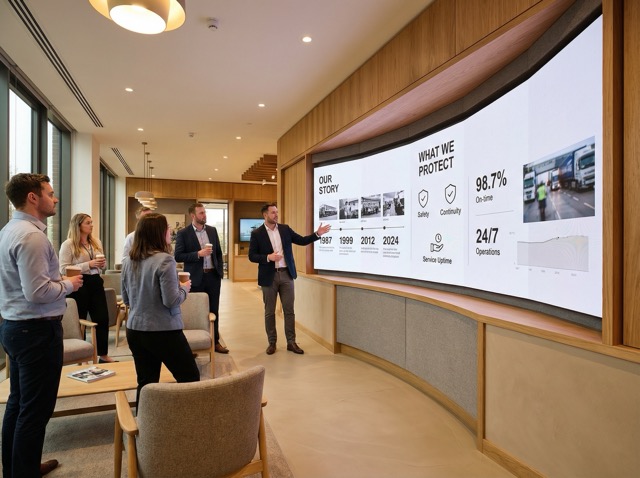
When the screen becomes part of the workplace, not a bolt-on
Corporate spaces carry more weight than they used to.
A reception lobby is a first impression and a security threshold. Meeting rooms have to handle hybrid calls, detailed content, and daylight. Experience centres are expected to explain complex businesses quickly and credibly. Control rooms need stable, legible information for long hours.
Direct view LED works in these environments because it behaves like an architectural surface. It can be built to the space, tuned to the light, and engineered for consistent performance over time.
Megascreens focuses on a specific niche: indoor, fine pitch direct view LED for brand-critical environments. The aim is simple. Make the display reliable, visually consistent, and calm to live with.
1) Reception lobbies that say something real
Most corporate lobbies fall into one of two traps.
They are either silent and under-expressive, or filled with generic “welcome” content that could belong to any company.
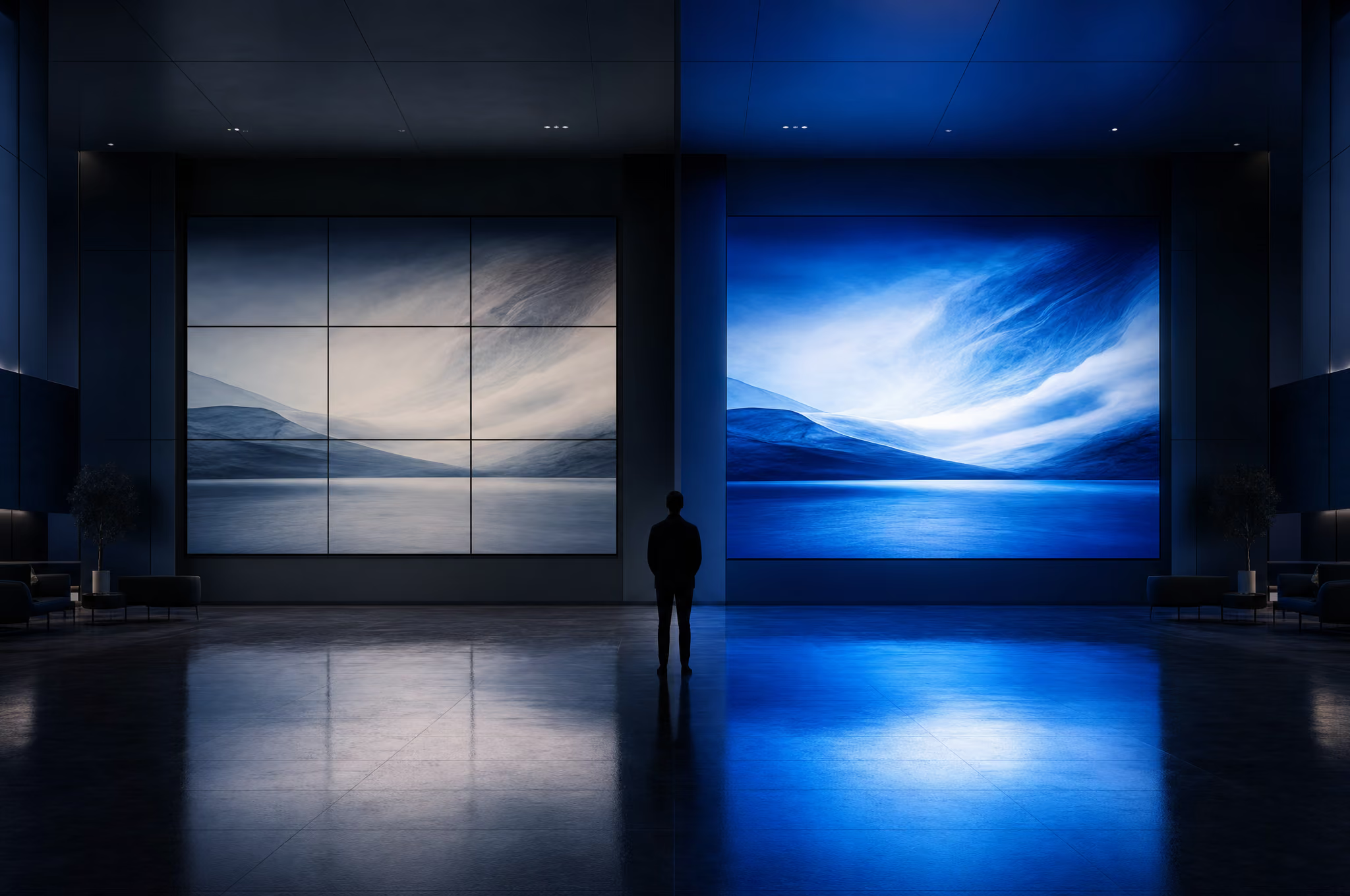
A fine pitch DV LED wall gives you a different option. A single surface that can carry the story of the business with clarity, without turning the lobby into a marketing zone.
What works well in reception environments:
- A restrained brand film loop with slow pacing and real imagery
- A simple “what we do” structure, built around outcomes
- Live operational context, if it’s meaningful (project locations, service coverage, network status)
- A values statement that is specific and provable, not slogan-led
Megascreens product fit:
MS Pro Series is typically the primary choice for permanent corporate lobby walls where close viewing, colour accuracy, and architectural integration matter.
2) Meeting rooms where daylight is a competitor
If you have a boardroom with glazing, you already know the problem. The best room in the building is often the hardest room to display in.
Projection washes out. Consumer screens struggle at scale. Even good displays can become visually tiring if brightness is pushed without control.
Direct view LED solves this when it’s specified properly:
- Screen size matched to the room depth and seating layout
- Pixel pitch matched to real viewing distance
- Brightness selected for ambient light, not for impact
- Content layouts designed for legibility in hybrid meetings
This is where DV LED earns its keep. It stays readable in mixed light, supports multi-window layouts, and gives senior rooms a calm, consistent visual anchor.
Megascreens product fit:
- MS All-in-One suits corporate presentation and meeting environments where speed, simplicity, and a clean integrated system matter. It’s strong for repeatable meeting rooms and training spaces with a standard 16:9 layout.
- MS Pro Series is the better option when you need a custom size, a more architectural integration, or closer viewing.
- MS Max Bright can be appropriate in unusually bright interior spaces where ambient light is a defining constraint, and the display must hold clarity without compromise.
3) Experience centres that make the business understandable
Many businesses are hard to explain. Not because they are secretive, but because their value is system-level.
Infrastructure firms. Logistics networks. Financial platforms. Engineering groups. Global services.
An experience centre gives you a structured way to bring that to life. It’s not a showroom. It’s a guided narrative space where customers, partners, and new hires can understand what matters and why.
Direct view LED supports experience centres because it can be built into the architecture and shaped around the journey, not forced into a rectangle.
High-performing experience centre content usually includes:
- A timeline wall that shows real milestones and scale over time
- A “how it works” sequence using clear diagrams and maps
- A values section backed by proof points (safety stats, service SLAs, uptime, reach)
- Case studies told simply, with the same visual discipline as the space
Megascreens product fit:
MS Pro Series is typically the right foundation for permanent experience centre walls because it delivers fine pitch clarity, stable colour, and long-term performance in design-led interiors. If parts of the experience centre are exposed to higher ambient light, MS Max Bright becomes relevant.
4) Control rooms where reliability is the product
Control rooms are not built for aesthetics, but they benefit from visual discipline.
Operators need stable information. The business needs confidence that the room can run long hours without drift, downtime, or inconsistency. Content must stay legible from multiple positions, often across an extended wall.
Direct view LED is well suited to this because:
- It scales into large continuous canvases
- It avoids bezels and visual breaks
- It can be configured for long operating hours
- It supports dense data layouts when pitch and content are specified correctly
The specification choices matter more than the headline. Viewing distance, pixel pitch, brightness discipline, and service access planning are what keep a control room wall predictable in year three, not just on install day.
Megascreens product fit:
For permanent control room walls, MS Pro Series is typically the right platform. It’s designed for close-to-mid viewing, stable visual performance, and architectural integration.
5) Corporate spaces are rarely “standard”, so the display should not be either
The real advantage of DV LED in corporate environments is not that it is “big”.
It’s that it can be built to fit:
- unusual wall spans and ceiling constraints
- recessed architectural details and joinery
- panoramic canvases for data and storytelling
- feature walls that must look intentional when the screen is off
In other words, it supports the space you actually have, not the space a standard display assumes.
What good looks like
In corporate environments, a screen succeeds when it feels inevitable.
It works every day. It looks consistent. It supports the room’s purpose. It does not demand attention to itself.
That outcome comes from three disciplines:
- Engineering that prioritises long-term reliability and serviceability
- Design integration that treats the screen as part of the architecture
- Content governance so the surface stays calm, current, and credible
This is where direct view LED stops being a “technology choice” and becomes part of how a business presents itself and operates.
Frequently asked questions
Yes. DV LED displays are well suited to healthcare settings due to their high reliability, long lifespan, and excellent visibility. When specified correctly, they can be used safely in reception areas, waiting rooms, consultation spaces, and staff-only environments.
LED displays help patients feel more informed and at ease by providing clear wayfinding, appointment updates, and reassuring visual content. In waiting areas, they can reduce perceived wait times and create calmer, more welcoming environments.
Yes. LED screens can support telemedicine consultations, staff briefings, and internal communications by providing high-resolution visuals, accurate colour reproduction, and reliable performance for video and data sharing.
Modern DV LED systems are designed for minimal maintenance. Front-serviceable modules allow quick repairs without disruption, and remote monitoring enables proactive support — making them ideal for environments where uptime is critical.